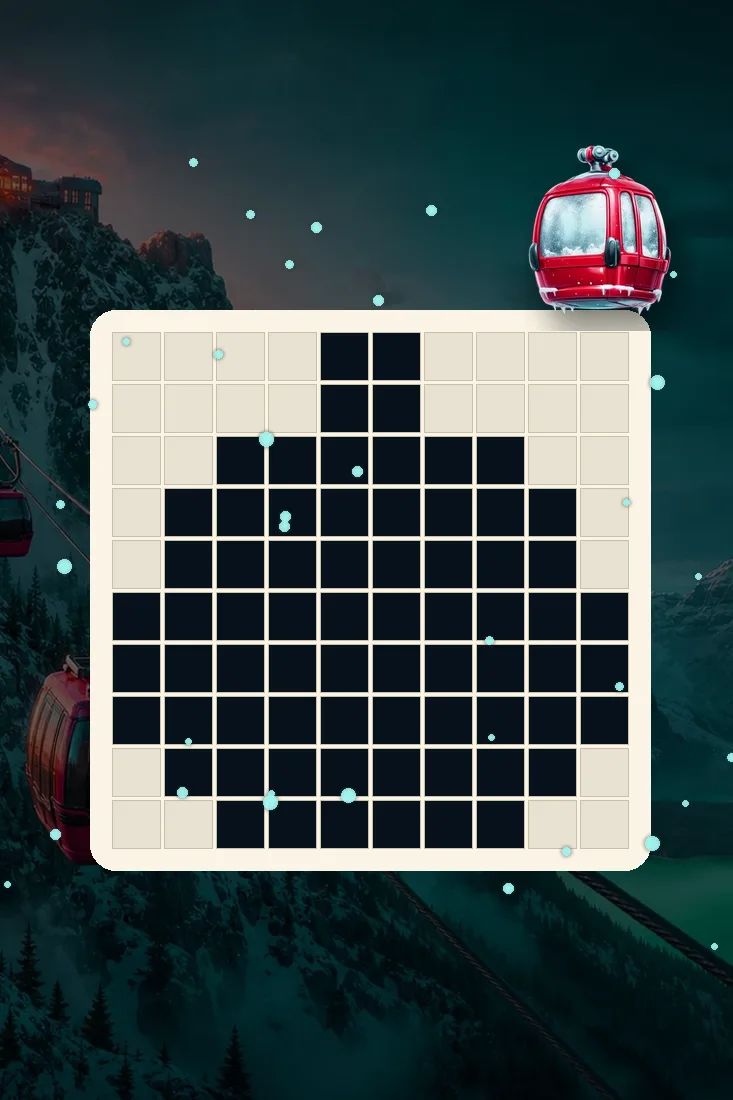
Trailmark Grids is our take on the picture logic puzzle often called a nonogram. You get an empty grid with a row of numbers beside every row and above every column. Each number is a run of filled squares, in order, with at least one gap between runs. Work out which squares must be filled and which must be empty, and a picture slowly appears out of the grid.
Every puzzle is made from one of twelve icons from the line: the gondola cabin, the bald eagle, the timber elk, the leaping trout, the lodge bell, the camp kettle and more. We shrink the icon down to the grid and use its outline as the solution, so the picture you uncover is a real silhouette from the mountain. Finish a puzzle and the icon appears in full colour.
How to play Trailmark Grids
- Choose one of the twelve motifs and pick a 10x10 grid to begin, or 15x15 for a longer think.
- Read the numbers by each row and column; each one is a run of filled squares in order.
- Fill squares you are certain about, and switch to cross mode to mark squares that must stay empty.
- Press and drag to paint along a row or column; matching clues highlight as you work.
- Complete every row and column correctly to solve the grid and reveal the full-colour icon.
Trailmark Grids controls
Getting better at Trailmark Grids
- Start with the biggest numbers. A run of 8 in a 10-wide row always covers the middle squares, wherever it sits.
- Cross out squares as soon as you know they are empty; crosses are just as useful as fills for later deductions.
- A row whose clue is 0 is entirely empty, so cross it out at once and use those blanks to help the columns.
- When you are stuck, scan the columns instead of the rows; a fresh direction often unlocks the next square.
- On a 15x15 grid, finish one corner fully before moving on, so your certain squares support each other.
How an icon becomes a puzzle
We did not draw these grids by hand. Each one is built automatically from an icon’s outline: the picture is drawn small, every square that is mostly covered by the icon becomes a filled square, and everything else stays blank. That way the silhouette you uncover is faithful to the art, from the curve of the eagle’s wings to the spikes on the spruce cone.
Not every outline makes a fair puzzle, so the game checks the result and adjusts any grid where rows or columns would arrive nearly empty. The aim is a puzzle that can be reasoned through from the clues, rather than one that leaves you guessing. A good grid should feel like a conversation with the numbers, and that is the feel we tuned for.
Ten by ten or fifteen by fifteen?
The 10x10 grids are where everyone should start. The clues are short, the picture is chunky and recognizable, and you can usually see the shape of the answer halfway through. It is a satisfying puzzle for a lunch break or a ride across town.
The 15x15 grids are another animal. There are more runs per line, more room for a single wrong fill to cause trouble later, and the picture stays mysterious for longer. The reward is a much more detailed silhouette. We find the bigger grids best on a winter evening with nowhere to be, which, in most of Canada, is a fair chunk of the year.
Questions about Trailmark Grids
There are twelve motifs, and each can be played as a 10x10 or a 15x15 grid, so the same icon offers a quick puzzle and a much deeper one.
Cross mode lets you mark a square you know is empty. Those marks do not count towards the picture, but they make the remaining deductions far easier to see.
You should not need to. Read row and column clues together and the next certain square is almost always there; guessing tends to cause more trouble than it saves.