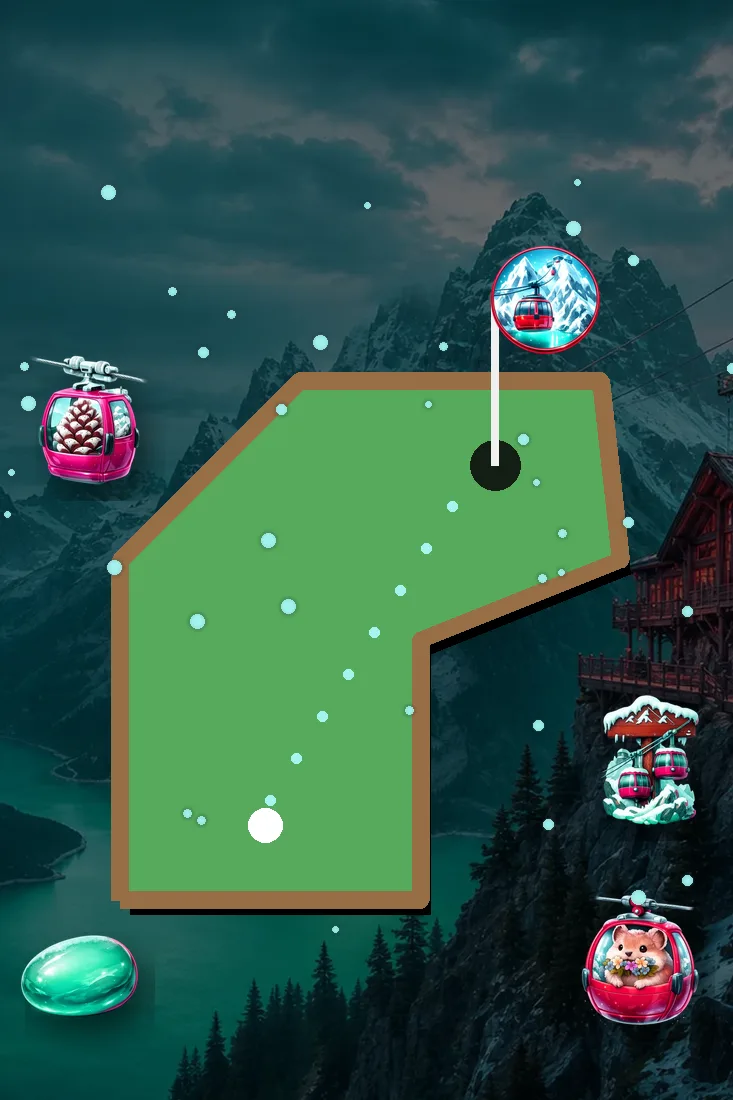
Switchback Putt shows each hole from directly above, like looking down at a course from a gondola window. Your ball sits on the tee, the cup waits somewhere past a bend or a barrier, and a little flag with our twin-peak badge marks the spot. Spruce cones, signposts, lake pebbles and a pika with a mouthful of flowers dot the edges as decoration, and they never get in the way of a roll.
To play a shot you press on the ball and drag back, the way you would pull a slingshot. A dotted guide stretches out in the opposite direction to show where the ball will head and how hard it is going. Let go and it rolls, slows with friction, bounces off walls and, with luck, drops. Each hole has a par, and your strokes land on a running scorecard.
How to play Switchback Putt
- Press Play to reach the first tee; the hole name and its par appear before you take a shot.
- Press on the ball and drag back. The further you pull, the harder the putt will be.
- Use the dotted guide to line up the direction, then release to send the ball rolling.
- Watch for slopes and sand that bend or slow the roll, and keep well clear of the water.
- Hole out on all nine greens, then check the scorecard to see how you finished against par.
Switchback Putt controls
Getting better at Switchback Putt
- On your first visit to a hole, take a softer shot than you think; seeing how the green behaves is worth a stroke.
- Timber walls give a true bounce, so a bank shot off the side is often safer than threading a narrow gap.
- Time moving gates by watching one full open-and-close before pulling back, then release just as the gap starts to open.
- Sand drags the ball nearly to a stop, so when your line crosses it, add a little extra power.
- When water sits beside the cup, play short and leave yourself a tap-in rather than risk going long.
Why every hole here can be holed
We did not want a course where luck decides whether a hole is possible. So every hole in Switchback Putt is built from a template we designed and tested by hand: a dogleg with a wall on the outside, a green split by bumpers, a slope that drifts the ball towards the water, a corridor with a gate that swings open on a steady beat. The course draws its nine holes from that library, and every one of them can be finished.
That does not make them easy. A slope that looks gentle will carry a fast putt well past the cup, and sand can stop a perfect line a foot short. But when a hole goes wrong, it goes wrong because of a choice you made, and on the next round you will know exactly which choice to change.
Reading the scorecard like a mountain guide
Par is the number of strokes a careful player should need, and it is printed with each hole name before you putt. Coming in under par on a hole feels wonderful; coming in a stroke over on Icefall Gate is perfectly respectable, because that gate is fussy. The card at the end lays out all nine holes side by side so you can see where the round was won and lost.
Our advice is to pick one hole at a time to improve. Most players have a nemesis, often the one with water beside the green, and finding a reliable line there will lower your total faster than trying to be brilliant on every green at once. Over a few evenings you will notice the card getting tidier, one hole at a time.
Questions about Switchback Putt
Nine, each with its own name and par. Together they make a full round, and your strokes add up on the scorecard as you go.
Water sends the ball back so you can try that shot again. The stroke still counts, which is why a careful short putt near the water is often the smart choice.
Yes. They open and close on a steady rhythm, so watching one full cycle before you release is the most reliable way to slip a putt through cleanly.